Thursday, 17 March 2011

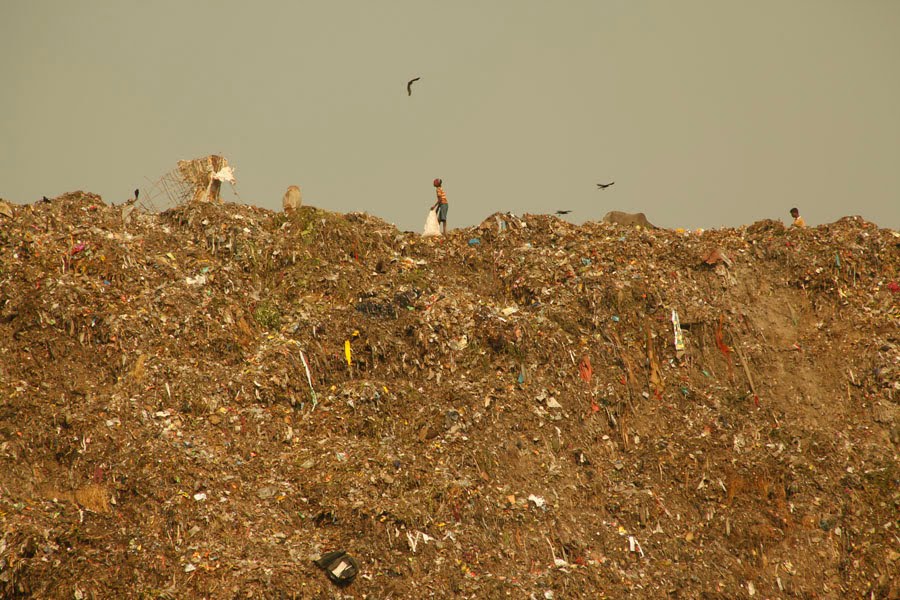
Kolkata’s dumping ground

Kolkata’s 25 ha dump is literally in the middle of the city. Near its entrance is a shopping mall, an international school and a park.

Surrounding this mountain of more than 30 meters of height thousands of people strive to live. Their livelihoods depend completely on the damp: they collect rag, or they work in the fisheries and plantations around it.

Corporal punishment by teachers, domestic violence, discrimination and child labour – mostly rag picking and domestic work – are common here. Even though many children are going to school, their future is uncertain. Many end up leaving school due to economic difficulties in the family. And those who manage to progress in their studies are disadvantaged vis a vis other children since the quality of government education is poor and Indian society continues to be segregated one.

In this district government institutions are almost absent. On the one hand, the government makes a blind eye to adults and children working in the dumping ground and it prohibits any type of photo documentary inside the walls of the dump to avoid putting its negligence on the spotlight of media. On the other hand, government’s presence is only felt before elections when promises are made, though hardly ever delivered.

To learn more about organisations working here, visit Development Action Society and Save the Children India. This photography project was commissioned by Save the Children.



Monday, 21 February 2011

Varanasi, one of the holiest cities in Hinduism

Pilgrims come to the Ghats in River Ganges to wash away their sins or to cremate their family and friends. The rituals start early in the morning and go until the evening when the ganga aarti- lighting of candles - ceremony is performed.

You routinely see dead bodies being carried in bamboo sticks through the alleys, you can venture and watch a whole body cremation in one of the public Ghats or opt to celebrate life by looking at someone lighting a lotus flower candle.

Varanasi is full of enchants and mysteries. Some we discovered, others we left untouched.


Wednesday, 2 February 2011

Corbett Tiger Reserve

It was great to spend a few days in the jungle and find peace amongst the animals.


Rajasthan

India, a country with lots of people, lots of noise, lots of colours, lots of flavours, lots of smells, a lot of poverty. Here everything is a lot: a lot of pollution, a lot of chaos, a lot of spirituality, a lot of rituals, a lot of monkeys, a lot of diversity, a lot of inequality, a lot of prejudice, a lot of admiration, a lot of dirt, a lot of cows, a lot of transports, a lot of smiles, a lot of fun!

In the middle of all these 'lots of' we are discovering our India. Forming or perspective about this country, which has an amazing history and some very smart and interesting people.


Tourists in India: everyone seems to love being in the picture!


26 January, Republic Day, Jaipur, India

The independence of India is a very much celebrated bank holiday. We spent the day with an NGO called I-India, celebrating with street children.

I-India is a very genuine NGO doing great work with orphans, sexually abused children, and children living in poverty. They provide education, training, counseling and general assistance to more than 1,000 kids living in Jaipur. A beautiful and moving work done by the Goswani family and supporters.